

EkkoSense adds early anomaly alerts for hybrid cooling
Wed, 25th Mar 2026
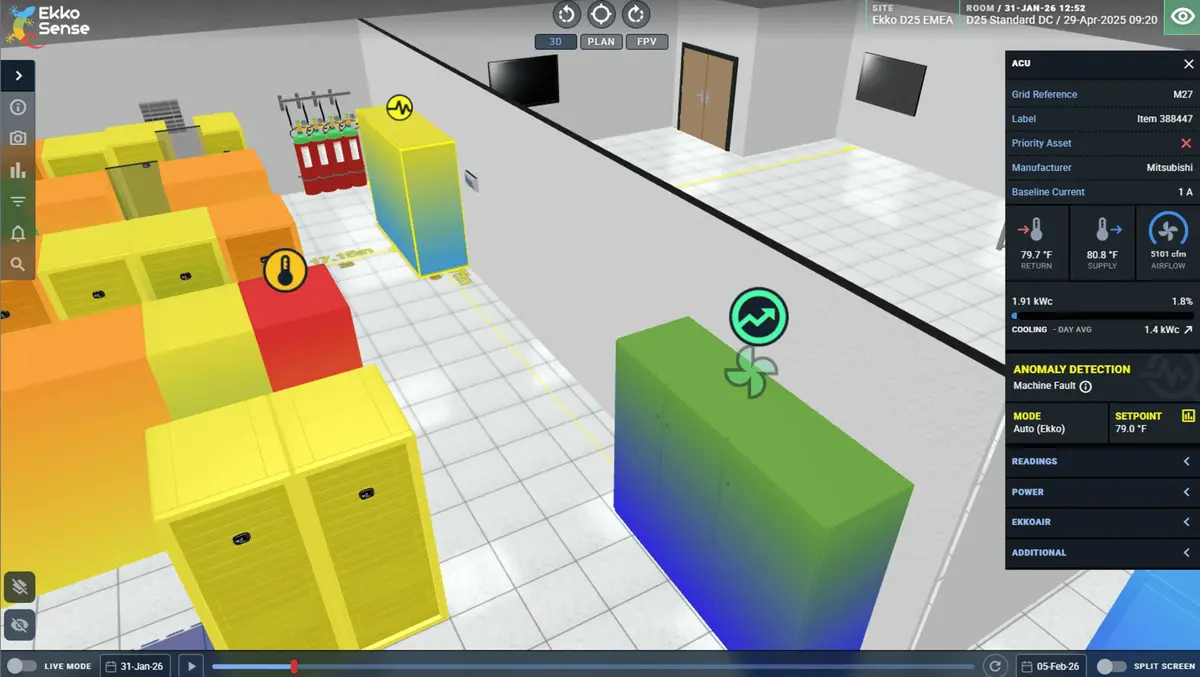
EkkoSense has launched an automated cooling anomaly detection feature for data centres, designed to work across both air and liquid cooling systems.
The feature is part of version 9.4 of EkkoSoft Critical software and is intended to identify irregularities in cooling performance before they develop into outages.
Data centre operators are under growing pressure to manage more complex cooling environments as higher-density computing increases heat loads and facilities combine traditional air cooling with liquid cooling equipment in the same room. In response, suppliers are looking to provide earlier warning of faults that may not yet trigger conventional building management or power monitoring alarms.
The new function is vendor-agnostic and can monitor hybrid cooling deployments, including chilled water infrastructure, cooling distribution units and chillers. It also covers airflow faults, chilled water flow-rate anomalies and changes in operating setpoints.
Early Alerts
The software allows operations teams to configure alerts for high readings, low readings or both, and to set notifications for individual items. Separate alerts can be created for liquid and air cooling units, while total power and cooling loads can also be included in notifications.
Alongside the anomaly detection feature, the latest release adds notification links through Teams webhooks and JSON webhooks for building management system integration. It also enables automatic setpoint detection by default, while retaining options for manual and actual setpoints and the ability to disable individual units.
These configuration changes are integrated into the Cooling Advisor tool, which provides operational recommendations on cooling performance.
Paul Milburn, Chief Product Officer at EkkoSense, said the increased use of liquid cooling and hybrid environments was changing the demands on facility teams.
"Successful liquid cooling deployments are all about understanding potential risks and having the right level of visibility into increasingly complex hybrid installations. And, given that today's high-density AI infrastructure is far more volatile with thermal conditions changing in real-time, data centre teams simply can't afford to rely on traditional lengthy BMS or EPMS alert mechanisms. If something's not performing optimally, they need to know now, before it fails," he said.
The aim is to help site teams move from reacting to alarms after thresholds have been breached to spotting signs of deterioration earlier in the operating cycle. This reflects a broader shift in the data centre market towards predictive maintenance tools tied to software analytics.
Hybrid Cooling
Cooling has become a more prominent operational issue as artificial intelligence workloads drive higher rack densities and sharper thermal fluctuations. These conditions can make it harder for operators to maintain stable temperatures using conventional approaches alone, particularly in facilities where liquid cooling is added alongside legacy systems rather than through a full redesign.
This creates a broader monitoring task. Operators must track not only room temperatures, but also the behaviour of individual cooling assets, water flow rates and shifts in configured setpoints, while keeping alert volumes manageable for on-site teams.
EkkoSense's software is intended to provide 3D visualisation and analytics across data centre environments, combining monitoring with operational alerts. The anomaly detection feature extends that by focusing specifically on cooling behaviour that may signal developing problems before they become visible through standard alarm thresholds.
Milburn said the feature is designed to warn of issues that sit below the trigger levels used by many existing management tools.
"That's where Auto Cooling Anomalies Detection has a key role to play, removing thermal and power risk by providing early warnings of any cooling infrastructure anomalies ahead of possible critical infrastructure failure for an asset that hasn't yet reached the threshold for generating a BMS alarm or a room temperature alert," he said.
Milburn added, "This also provides data centre operations team members with the ability to triage air and liquid cooling issues and move beyond traditional reactive data centre monitoring to a more proactive maintenance approach."