

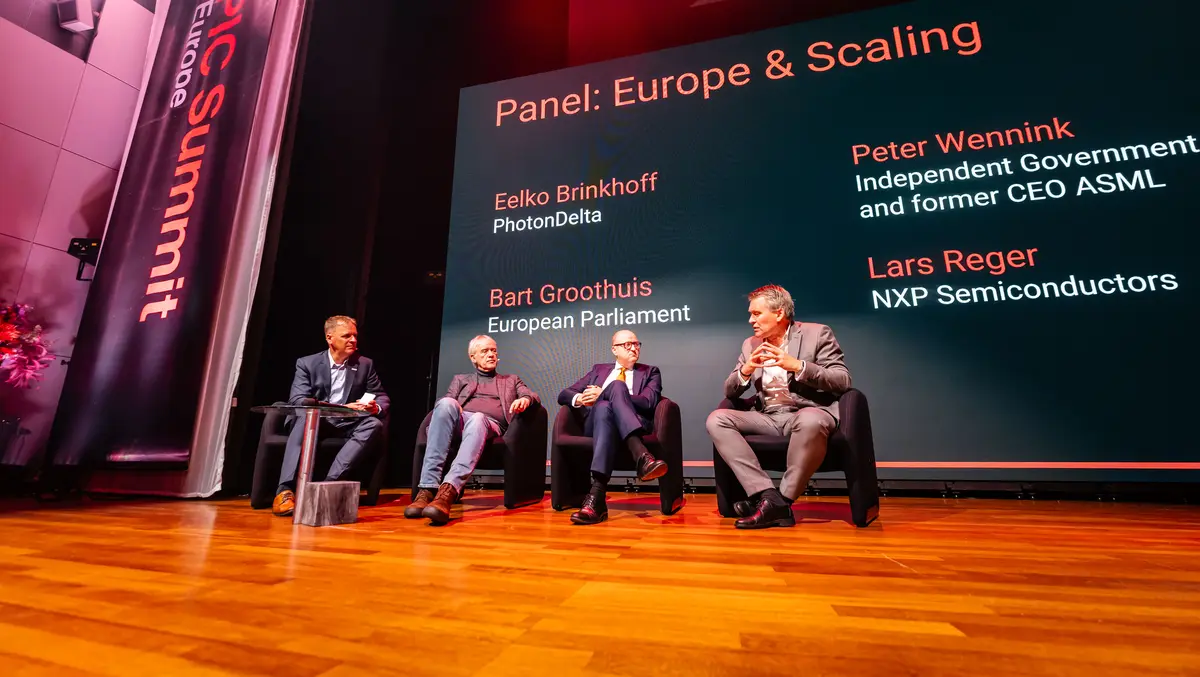
Europe urged to speed up integrated photonics scaling
Fri, 20th Nov 2026 (Today)
PIC Summit Europe 2026 brought together photonics industry leaders in Eindhoven to press for faster scaling and greater cooperation in integrated photonics. Speakers said Europe must move quickly if it wants to turn its position in the field into industrial production.
More than 900 people attended the fifth edition of the summit, according to organisers, making it the largest in the event's history. Business executives, government officials and academic leaders from across the semiconductor and photonic chip sector took part, including representatives from NXP, STMicroelectronics, Soitec, SMART Photonics, HyperLight, NTT, Axelera AI, Foxconn and the European Commission.
Discussion focused on how integrated photonics can move from research and early deployment to larger-scale manufacturing. Participants examined its role in AI and data infrastructure, quantum computing, sensing, healthcare, agrifood and automotive, while also addressing the practical barriers to wider production.
A recurring theme was Europe's need to move faster on manufacturing capacity, infrastructure, talent and regulation. Speakers argued that integrated photonics remains one of the few areas where Europe still holds a meaningful position against the US and China, but warned that this advantage could narrow without quicker execution.
"Integrated photonics is one of the few technologies in which Europe is not lagging behind the US and China. The potential we have here is enormous.
"We need to scale faster. We don't measure in billions or in numbers of fabs. We measure the number of months businesses have to build new factories and fabs. So many different companies can, by working together, create something beautiful," said Bart Groothuis, Member of the European Parliament.
Peter Wennink, former Chief Executive Officer of ASML and now an independent government adviser, also called for more supportive conditions for companies trying to expand in the sector. He pointed to infrastructure, skills, simpler regulation and access to capital as central issues for policymakers.
"It's very important that Europe creates the conditions for these companies to thrive and grow faster. That means infrastructure, talent and simpler regulations so that startups and scaleups can expand more quickly," said Peter Wennink, Independent Government Adviser and former Chief Executive Officer of ASML.
Wennink also referred to a €1.95 billion proposal for high-volume photonic chip manufacturing that he has included in advice to the Dutch government. He said projects on that scale would depend on the broader ecosystem being put in place.
"We cannot wait. It's now or never," he added.
Industrial push
The summit's focus reflected a broader shift in the photonics sector from technical progress to industrialisation. Organisers framed the event around scaling integrated photonics for wider global use, with particular attention to data communications and other markets that may require larger manufacturing volumes.
Eelko Brinkhoff, Chief Executive Officer of PhotonDelta, said the sector would need international cooperation as well as technical progress in packaging and testing. He also linked demand for photonic chips to the growth of AI infrastructure.
"We need international collaboration. We need the world to adopt this new technology, and we need collaboration to scale it and solve challenges we still see in areas such as packaging and testing.
"Integrated photonics has become a key enabling technology for AI infrastructure, driving unprecedented demand for photonic chips in data communications. I believe this momentum will also accelerate the adoption of photonic sensing, enabling smarter, more intelligent systems at the edge. This opens the door to a range of new solutions in healthcare, agrifood, robotics, mobility and defence," said Eelko Brinkhoff, Chief Executive Officer of PhotonDelta.
Executives and researchers at the event also discussed the technical demands of integrating photonics into commercial systems. Rene Jonker of Soitec pointed to the importance of thermal management as systems become more complex and combine different optical functions.
"The future of photonic systems will be heterogeneous photonics. If you start adding active optical components to the system, thermal management becomes very important," said Rene Jonker, Executive Vice President and Chief Product Officer at Soitec.
Other speakers highlighted applications beyond communications infrastructure. Natalia E. Uzunbajakava of TNO pointed to biosensors, consumer devices, automotive uses and defence as areas where integrated photonics could be applied.
"Integrated photonics can enable different classes of biosensors. Think about wearable watches, smartphones and automotive applications. Another class is so-called point-of-care biosensors. We also have domains including defence, safety, security and space," said Natalia E. Uzunbajakava, Senior Scientist Integrator at TNO.
The event has expanded sharply in recent years, growing from a regional gathering of around 300 people in 2022 into a larger industry summit with international participation and a stronger emphasis on manufacturing scale.